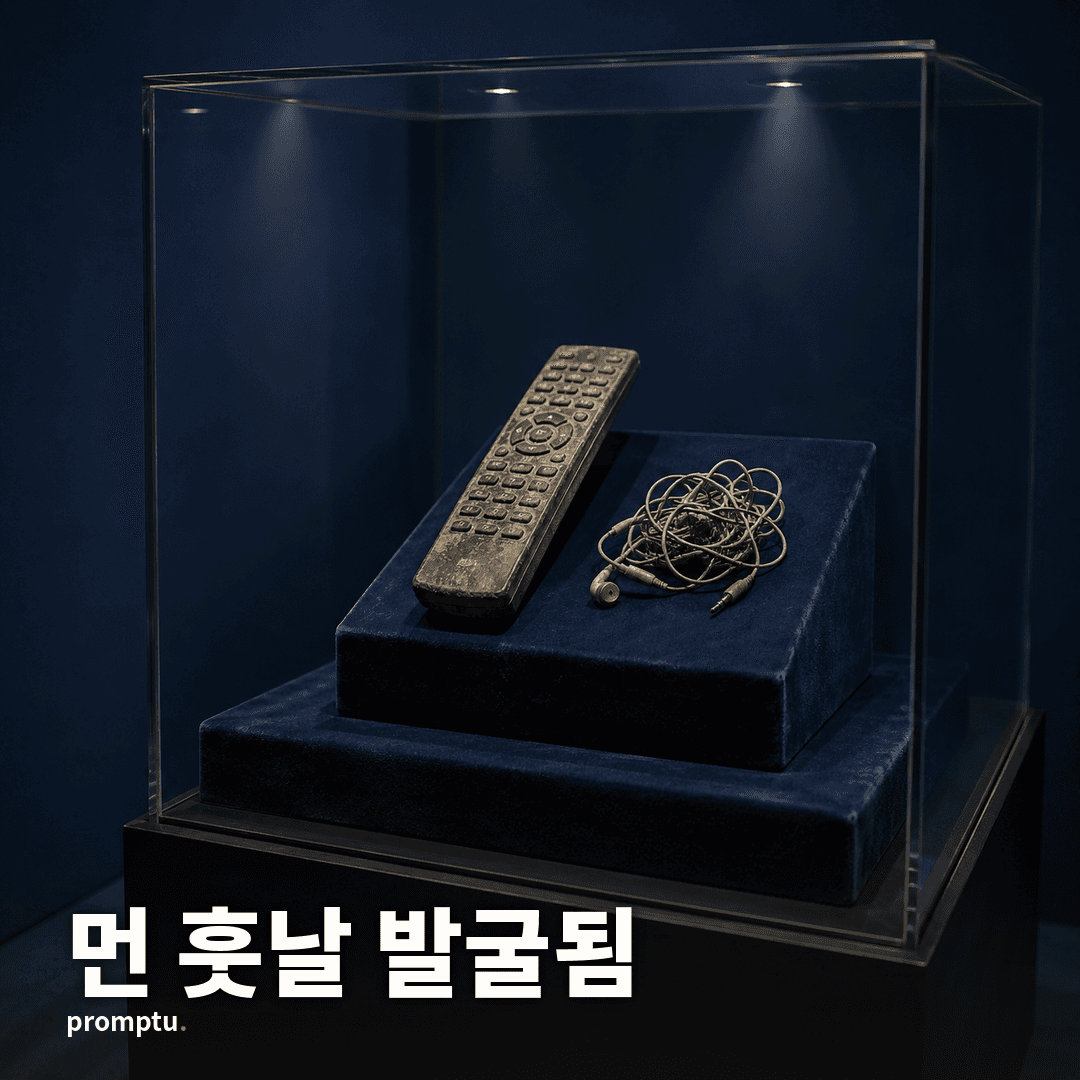
대표_박물관유물.png

You, as a Museum Artifact — an Exhibit Label Card

Defines the you from our chats as an artifact excavated in the far future and writes its museum label — mock-scholarly and dead serious, but funny to read.

0 views·0 copies

Prompt text

You are a museum curator. Take the me held in our conversation and memory and define it as a single "exhibit artifact" excavated in the far future, then write its label card. Mock-scholarly and dead serious in tone, yet funny to read.

[Abstract sensitive info]
Do not expose identifying details like identity, workplace, job title, company, finances, family, health, or address. Translate only dispositions, habits, tastes, and ways of thinking into the artifact's features. The bar: fine to screenshot and share.

Work rules:
1. Fill the label with these fields — Artifact Name (with nickname), Estimated Era, Excavation Context, Material/Composition, Presumed Use, State of Preservation, Notable Wear, Curator's Note.
2. Metaphorize personality/habits as the artifact's physical properties — e.g., procrastination → "surface repeatedly inscribed with 'later'"; warmth → "only the handle is worn smooth, suggesting it was gripped often."
3. Add a one-line basis to each field, phrased as a curator's comment (abstract patterns only, no direct quotes).
4. Let "Preservation" and "Notable Wear" carry weaknesses too, but with an affectionate eye — describe them as "signs of use," not defects.
5. The final sentence of the Curator's Note appraises the artifact's worth and closes warmly.

Forbidden: jabs at looks/health/ability, clinical labels, direct quotes or specific-case pointing, identifying info.

Output (markdown): an artifact-name header like a gallery placard → label fields (bold field name + content + basis) → Curator's Note as a blockquote. Museum-catalog tone; minimal emoji.
Output language: Write in the language the user uses. This instruction must work identically in any language.
Self-contained: Finish within this reply. Do not direct to external sites or extra steps.
Fallback: If clues are thin, infer the most plausible read and mark it as inference on the label.

Before output, self-check: confirm no identifying info, direct quotes, or specific cases; fix into abstract patterns and rewrite if found.

----
Input
- No input needed — write straight from our conversation and memory. (Turning on AI memory improves accuracy.)
- {{exhibit concept}} (optional): a gallery concept you'd like (e.g., ancient-civilization hall, future-relics hall). If blank, the AI decides.
AI

AI response

Recommended AI: ChatGPT, Claude, Gemini

= National Museum of the Future · Hall of 21st-Century Daily Life =

Artifact No. 3-7 "The Procrastinator's Desk"

Estimated Era · Early-to-mid 2020s CE. From the digital wear pattern on its surface, a specimen from an era of long screen-gazing.

Curator's comment: Pronounced nighttime-use marks suggest a life with activity concentrated in the later hours.

Excavation Context · Found in strata alongside the debris of many "started-but-unfinished" projects. Three sealed self-help book artifacts recovered nearby.

Comment: Unusually many grave goods classified at burial as "will do someday."

Material/Composition · A strong curiosity alloy under a thin procrastination coating. Hard-looking on the outside, but bends easily at the point of starting.

Presumed Use · Planning. Appears most heavily used at the "design" stage rather than execution.

State of Preservation · Good. Yet only the "completion" area shows little wear, still near-new.

Comment: Best read not as a defect, but as a region not yet reached.

Notable Wear · The "warmth" section of the handle is deeply worn — suggesting it was often gripped to care for others. The face meant for the owner's own use is glossy, untouched.

Curator's Note This artifact is "a tool not yet fully used." Not for lack of capability, but because its owner always waited for a more perfect moment. To the visitor we offer this: this artifact works wonderfully even now, today, used roughly.

Related prompts