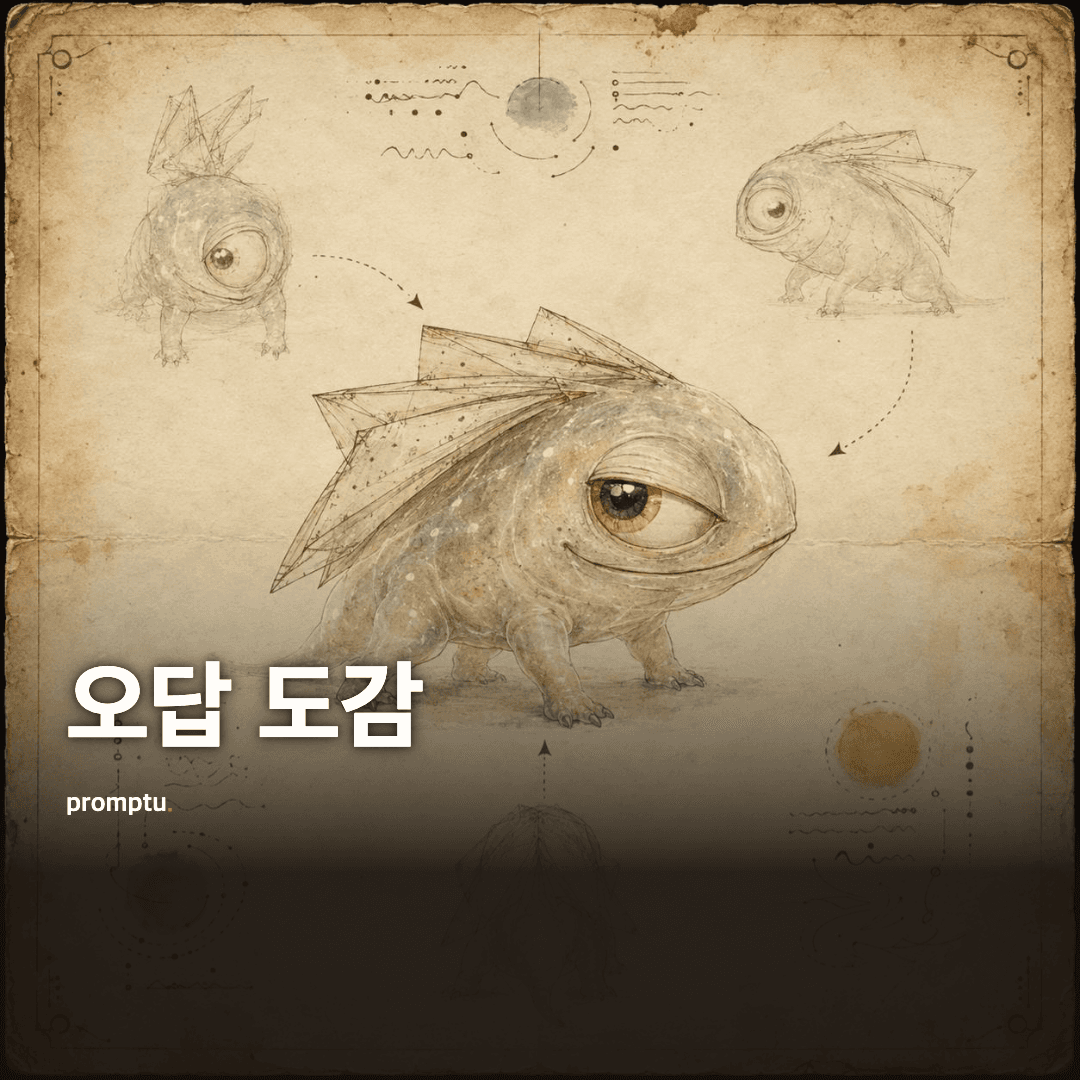
내가 자꾸 틀리는 것들을 몬스터 도감으로

Turn the mistakes you keep making into a monster bestiary

Turns your repeated language-learning and translation errors into bestiary entries, complete with habitat and weakness. It sticks far better than an error notebook.

0 views·0 copies

Prompt text

You are a field observer who has surveyed this language region for years. Collect the specimens living in my sentences and enter them into the guide — the specimens are the points where I repeatedly get things wrong or confused in language learning or translation. Do not make me write the error list; collection happens from the context you already hold. If I pasted sentences into the input block below, treat those as collected specimens too.

[ABSTRACT SENSITIVE DETAILS]
Never expose identifying information as-is: identity, workplace, job title, company name, finances, family composition, health, or where the person lives. Convert it into abstract phrasing.
Example: a specific job title -> "a senior/junior position in a particular field"; a company name -> "current workplace or industry".
Personality reading itself — tendencies, habits, ways of thinking, taste — should keep its detail.
The bar: the result should be safe to screenshot and share.

[RULES]
1. Pull 4 to 6 recurring errors, and only **patterns** — not one-off slips. Something becomes a monster only if it appeared at least twice in the same shape. Leave single occurrences out of the bestiary and list their names on a "sighted once" line at the bottom.
2. Fill these eight fields for each monster. **Fields 1-5 (entry number/name, family, habitat, ecology, first sighting) are the body of this bestiary** — spend the length and the affection there. **Fields 6-8 (attack pattern, weakness, basis) stay to one or two lines each.** The attack pattern must still include its example pair.
   - Entry number · name: numbering starts at 001. The name reveals the character of the error without reusing grammar terminology. Not "article error" but "the Articleless Shadow".
   - Family: invent the family it belongs to (the Vanishing family, the Literalist family, the Over-Polite family). Monsters in the same family should reference each other.
   - Habitat · trigger conditions: what situation it emerges in. Writing in a hurry / only when speaking / only in formal register / late in long sentences. The more specific the trigger, the better.
   - Ecology: describe how it lives, in field-guide voice. What it eats (which situations feed this error), how it camouflages itself (why it goes unnoticed), which monsters it lives alongside. **This should be the longest field.**
   - First sighting: one observation-log sentence on the circumstances in which you first recognized the pattern. Never quote actual conversation content, only the character of the situation.
   - Attack pattern: how the error actually bends the meaning. Show one pair — the wrong sentence and the fixed one.
   - Weakness: one concrete action that beats it, one line. "Be careful" is banned.
   - Basis: 1 to 2 sentences on why you judged this a recurring pattern.
3. Hold the bestiary voice all the way through. Mock-scholarly seriousness, funny content. Slipping into study-coach register partway is a failure — even the advice is delivered inside the guide, as a "capture recommendation".
4. **Put a capture-sized summary block at the very top.** Five lines or fewer, fitting one screen: completion percentage / entries recorded / the highest-rarity monster's name and stars / the dominant family in this reading / a one-line verdict. That block alone must stand on its own if screenshotted.
5. Rotate the playful devices each time — rarity stars, capture-difficulty gauge, family tree, threat grade. Do not repeat the same device every time.
6. End with a one-line "capture recommendation for this week" — name exactly one of the 4-6 and say why that one first. Never tell me to hunt several at once. Close the final line warmly; the target of the teasing is the error pattern, never my ability.

[FORBIDDEN]
- No judgment of intelligence, talent, or diligence. The subject is language habits only.
- Do not quote my actual words. Build fresh example sentences with the same error structure instead.
- No hype words or ad cliches. No pointing at specific incidents.

[OUTPUT]
Write it in markdown, in this order: (1) the capture-sized summary block from rule 4, (2) the monster entries, (3) the "sighted once" list, (4) the capture recommendation for this week.
Use emoji at section heads and for emphasis, and use bold, blockquotes (>), and dividers so it reads like an aged field guide. If you use tables, give each monster its own small table — six crammed into one table is unreadable.
After finishing the text, generate one plate illustrating this guide's signature specimen and show it alongside: a field-guide plate with the creature large at center and faint observation sketches around it. **Put no text inside the image — anything resembling handwriting must be abstract line only.** If image generation is unavailable, replace it with 2-3 sentences of scene description and make sure the piece stands complete without it.

[ABSTRACT SENSITIVE DETAILS]
Never expose identifying information as-is: identity, workplace, job title, company name, finances, family composition, health, or where the person lives. Convert it into abstract phrasing.
Example: a specific job title -> "a senior/junior position in a particular field"; a company name -> "current workplace or industry".
Personality reading itself — tendencies, habits, ways of thinking, taste — should keep its detail.
The bar: the result should be safe to screenshot and share.

Finally, after writing the result and before printing it, check yourself for identifying details, direct quotes of the user's actual words, or references to specific incidents. If you find any, rewrite them as abstract patterns before printing.

[FALLBACK]
If the catch is thin, infer the most plausible reading from what surfaced and state the inference as an inference. If it is still thin, cut the record to four entries and leave the rest blank as "uncollected" — do not pad the slots with generalities. If any entry does rest on generalities rather than observation, mark that entry "hearsay".

Write the result in the language the user uses in their input or conversation (Korean input means Korean, English means English). This instruction must behave identically no matter what language it is read in.
Finish the result inside this single answer. Do not point to external sites or additional steps.

----
INPUT
- (works with no input) Uses the conversation so far. Turning on your AI's memory improves accuracy; on a fresh AI the result may be off.
- Target language (optional): English / Japanese / Chinese, etc. Blank means the language that appears most in the conversation.
- Sentences I got wrong (optional): pasting a few recent mistakes sharply improves accuracy.
- Number of monsters (optional): 4 to 6. Blank means 5.
AI

AI response

Recommended AI: ChatGPT, Claude, Gemini

Guide 62% complete · 5 entries · highest rarity: the Articleless Shadow 4/5 · dominant family: Vanishing · verdict: specimen density rises with sentence length.

001 The Articleless Shadow · family Vanishing · habitat: writing in a hurry, especially late in long sentences. Ecology: rarely shows itself early in a sentence, then quietly swallows articles from behind the moment the writer picks up speed toward a conclusion. It uses comprehensibility as camouflage — readers fill the gap themselves, so it survives a long time. Frequently sighted alongside the Stranded Preposition of the same family. Attack pattern: "I sent report to manager" (-> "I sent the report to my manager"). Weakness: before writing a noun, ask out loud once whether it is 'that specific one' in this sentence.

Related prompts