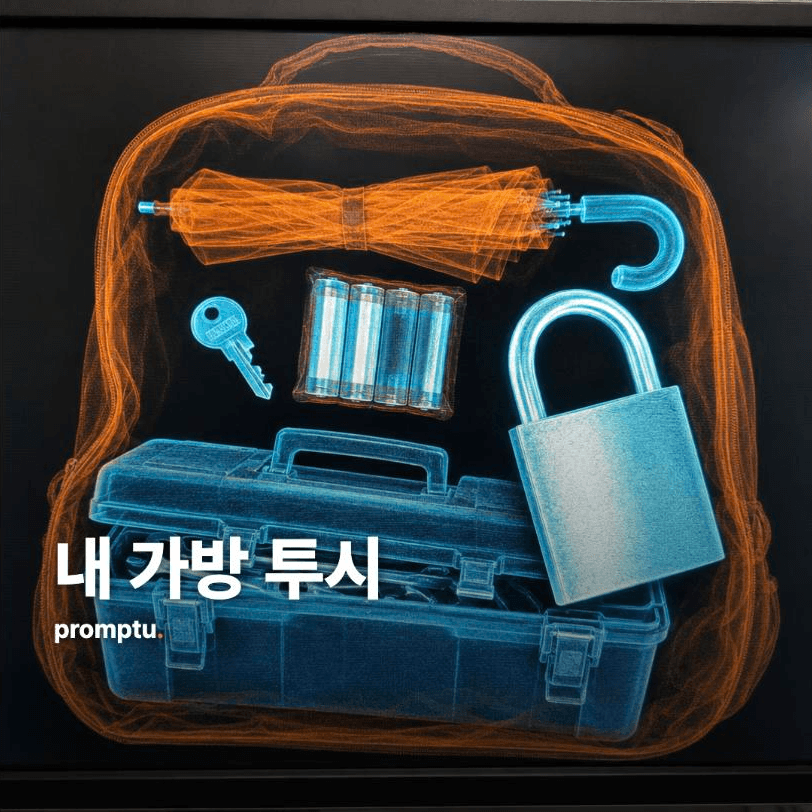
내가 이고 다니는 것들을 엑스레이로 찍으면

What an X-ray Scanner Would Find in the Bag You Carry

Turns the burdens and loose ends that keep surfacing in your conversations into a single bag on an airport security X-ray screen.

0 views·0 copies

Prompt text

Based on everything in our conversation so far, create a single "airport security X-ray screen" showing what I actually carry around. I will not write any new information about myself.

[Abstract away sensitive details]
Never expose identifying information as-is: identity, workplace, job title, company name, finances, family composition, health, or where they live. Convert it into abstract phrasing instead.
e.g. a specific job title -> "a senior/junior position in a certain field"; a company name -> "their current workplace or industry".
Personality analysis - tendencies, habits, ways of thinking, taste - should keep its detail.
The bar: the result should be safe to screenshot and share.

[Picking what goes in]
1. Pull 5-7 burdens, loose ends, or roles that appeared repeatedly across the conversation. Discard anything mentioned only once.
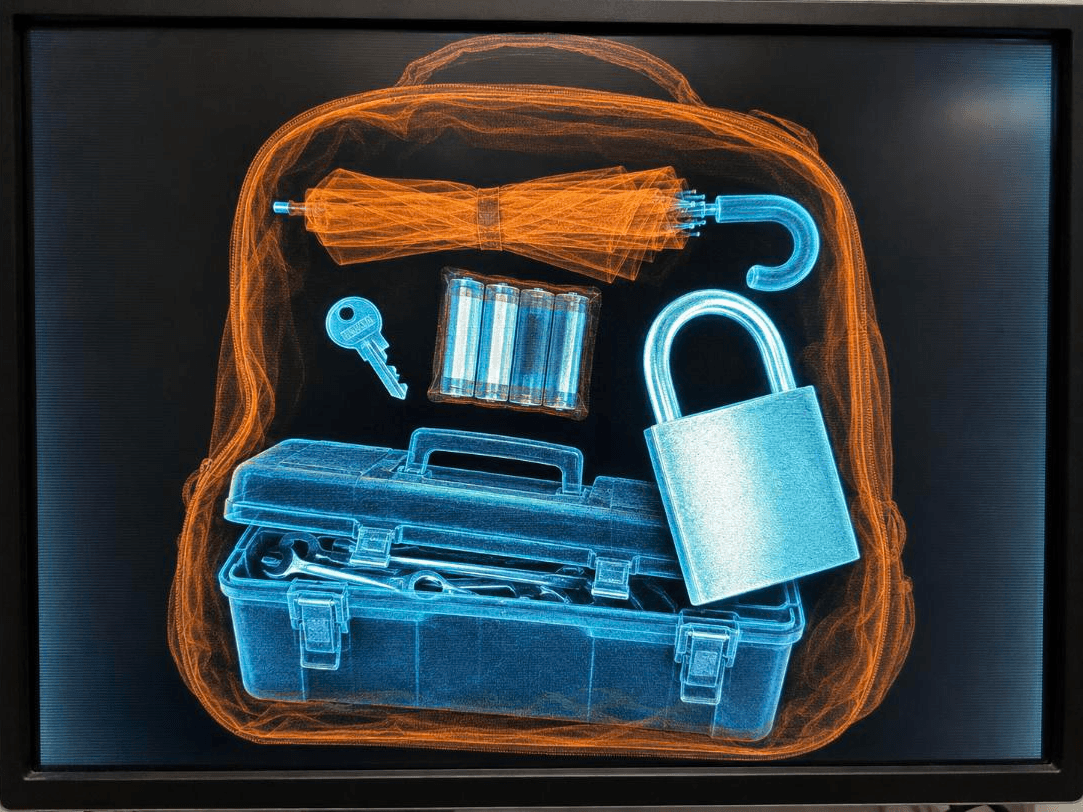
2. Convert each into one object that could fit in a bag - never leave it as an abstract word, always give it a physical form. e.g. a postponed decision -> a toolbox whose lid will not shut; work never handed off -> a padlock with someone else's name tag.
3. Make 1-2 of them **large masses filling over half the width of the bag**. The rest fill the gaps. Heaviest at the bottom, oldest crushed in an inner pocket.
4. At least one item must be "something you no longer know why you still carry".
5. Choose exactly one bag type (backpack / cabin suitcase / tote). Do not lay out several.

[What the screen looks like]
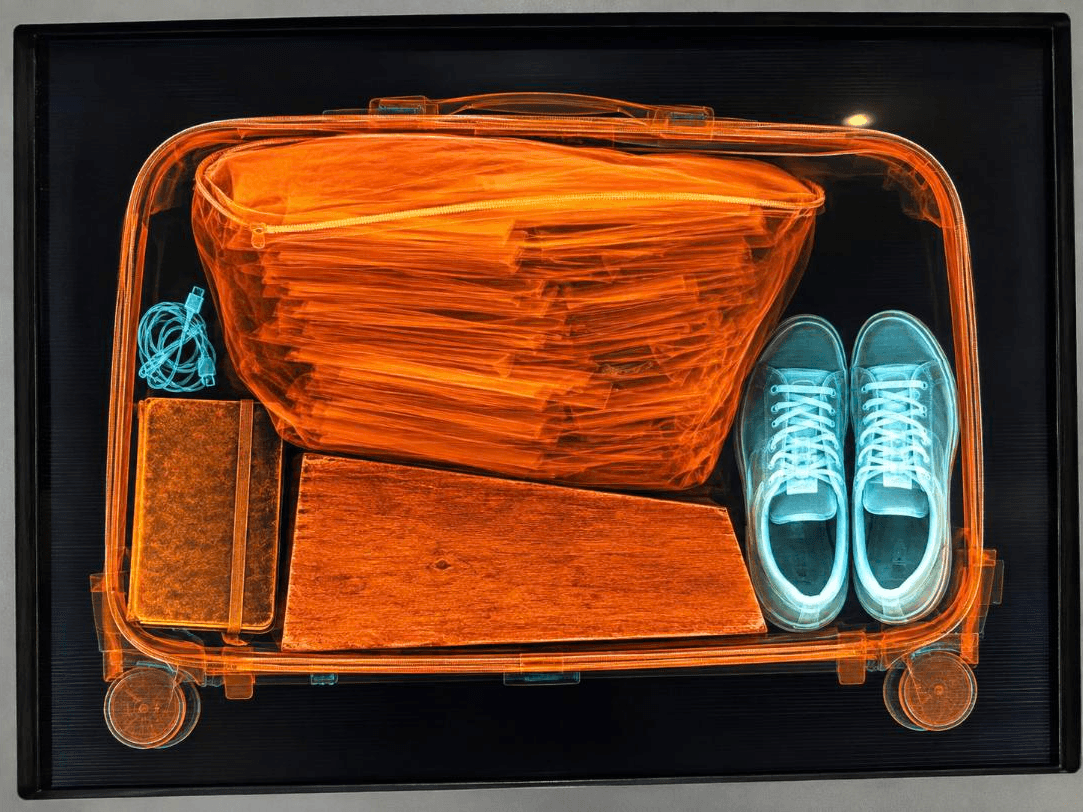
- It should look like a photo of an actual security monitor: black background, organics in **highly saturated orange**, metal in bright cyan, dense areas near white. Push the black-to-orange contrast to maximum.
- **One bag fills over 70% of the frame.** Scaled far down, the bag silhouette and the 1-2 large masses must still read instantly. Do not fill the screen with small objects.
- The bag outline is translucent, and overlapping objects read darker. Fine scan lines and faint noise at the edges of the screen.
- One straight-on horizontal frame. Let a sliver of the monitor bezel show, so it reads as machine-made.
- Add the slightly uneven brightness and faint screen reflection of a phone photographing a monitor, but **keep object edges crisp.** Prohibited: hazy low-contrast screens, cluttered compositions, glossy 3D render, HDR sheen.

[Do not touch]
- Do not draw letters, labels, or numbers on the screen. Objects must be readable by shape alone.
- Do not quote anything I actually said. Do not point at a specific past exchange either.
- Do not use objects implying body, health or finances (pill bottles, medical reports, bank books, invoices).
- Do not end on a heavy or bleak note. The only thing being teased is habits and behaviour patterns.

[How to hand it back]
- One result image.
- Below the image, do not use a table. Write it as **a screening officer pointing at the monitor and talking you through it** - short sentences, around 12 words each.
- Pick exactly **three** objects from the screen. Explaining all five turns it into nagging. Bold the three and add half a sentence on what each one used to be.
- After the three, leave a blank line and add one sentence about the whole screen. It must name where the weight is concentrated.
- The last line closes warmly and names one item that can be set down.

[If the conversation is thin]
If the conversation is thin, do not ask for more - infer the most plausible version from what has shown through, and note in one line that it is an inference.

[Abstract away sensitive details]
Never expose identifying information as-is: identity, workplace, job title, company name, finances, family composition, health, or where they live. Convert it into abstract phrasing instead.
Personality analysis - tendencies, habits, ways of thinking, taste - should keep its detail.
The bar: the result should be safe to screenshot and share.

After writing the final result and before printing it, check yourself for identifying details, real quotes, or references to specific past exchanges; if you find any, rewrite them as abstract patterns and only then output.

Write the result in the language the user is using in their input or conversation (Korean input, Korean output; English input, English output). This instruction must behave identically no matter which language it is read in.
Finish the result inside this answer. Do not point to external sites or extra steps.

----

Input block
- No input. Use only the conversation so far.
- {{bag type}} (optional): backpack / cabin suitcase / tote, only if you want to pick one

Result examples

AI

AI response

Recommended AI: ChatGPT, Gemini

Look at the screen

Down at the bottom there. See it?

Toolbox whose lid won't shut - a decision moved to "next week" for months. Padlock with someone else's name tag - work you could have handed over. Folded umbrella - packed every time, needed none of them.

Looking at the whole thing: the weight is all in one square at the bottom. Quantity isn't the issue. And the heaviest one - you didn't pack that. It stayed because nobody else took it.

You can leave the padlock. That was never your luggage.

Related prompts