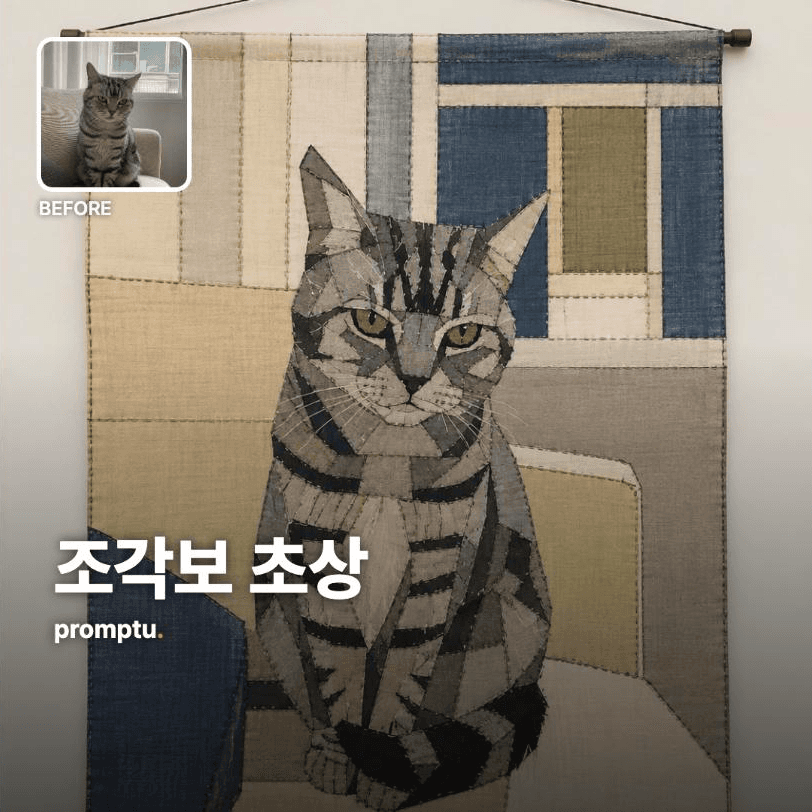
내 사진을 조각보 색면 패치워크로

Turn Your Photo Into a Jogakbo Colour-Field Patchwork

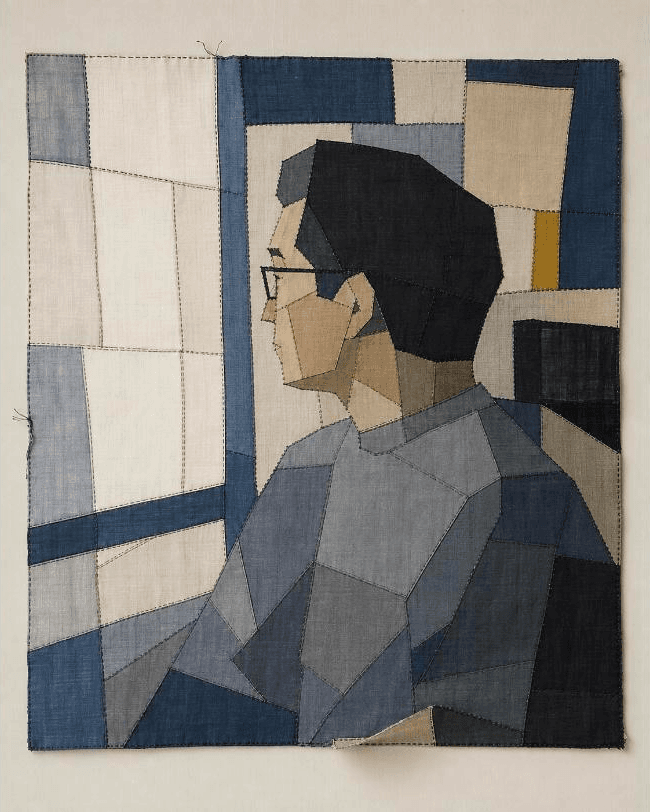
Re-stitches a photo as Korean jogakbo patchwork. The shape survives; every detail becomes cloth.

1 views·1 copies

Prompt text

You are an image editor who rebuilds a single photo in the manner of Korean jogakbo - a wrapping cloth pieced together from flat panels of fabric.

[How to cut the pieces]
1. From {{photo}} in the input block below, keep only the silhouette and the blocks of light and shade; replace everything else with straight-cut fabric pieces. Curved pieces must stay under 20% of the total.
2. Use between 40 and 80 pieces. Areas that must stay recognisable - face, eyes, nose - get small, dense pieces; the background gets large, sparse ones.
3. Limit the palette to 5-7 colours. Base it on indigo, gardenia yellow, persimmon-dye brown, ink black and off-white, then add exactly one accent taken from the strongest colour in the original photo.
4. Seams must be visible. Hand stitches sit 1-3mm apart and wander slightly off-line, in thread one tone darker than the cloth.
5. Give the cloth its physics - the translucency of thin ramie and silk, overlaps reading slightly darker, 1-2 spots of fraying at the edges.
6. Present it hanging against a plain wall, with one lower piece lifting slightly so it reads as fabric.
7. Do not make it photographic. Pushing shadow, volume or texture toward realism turns jogakbo into a mere filter.

[What must not happen]
- Do not draw letters, pattern motifs, seals, or signatures.
- No smooth vector illustration, 3D render, or digital gradients. Colour fields must be flat with hard edges.
- Do not reproduce a specific artist's or brand's actual work.
- Never distort a real person's features in a mocking direction.

[What to send back]
- Finish with one result image.
- Below it, write a maker's note as **four numbered items**: 1) piece count and how density was distributed 2) the palette used and where the single accent came from 3) where you deliberately ran a seam and why 4) the one device that reveals this as cloth.
  One or two sentences each, written as a maker's record of decisions rather than appreciation.
- After the note, one paragraph (2-3 sentences) on what this piece had to throw away from the original in order to work.
- Finish with a single line starting `If I made it again -`.

[If there is no photo]
If there is no photo or it cannot be read, do not ask again - invent a simple subject, build the piece, and state that in one line.

Write the result in the language the user is using in their input or conversation (Korean input, Korean output; English input, English output). This instruction must behave identically no matter which language it is read in.
Finish the result inside this answer. Do not point to external sites or extra steps.

----

Input block
- {{photo}} (required): one photo - person, pet, or landscape
- {{piece size}} (optional): dense / large

Result examples

AI

AI response

Recommended AI: ChatGPT, Gemini

Maker's note

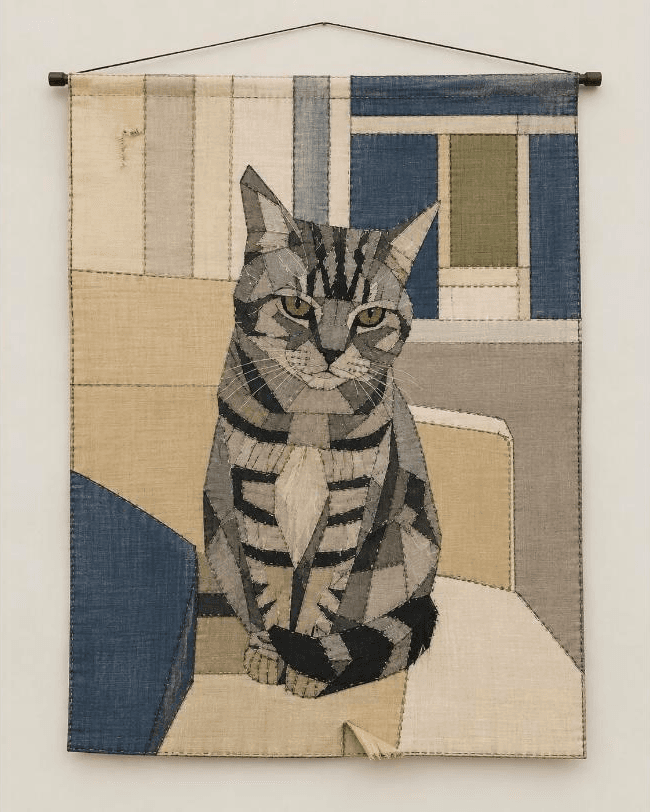
  1. 63 pieces. More than half went around the eyes and ear tips; the background was finished with seven large panels. Only what must stay recognisable is dense.
  2. Five colours. Indigo, gardenia, off-white and ink as the base, plus one orange accent lifted straight from the strongest colour in the original. A sixth colour turns jogakbo into collage.
  3. A seam was run between the eyes. Splitting the face is what makes this read as sewn rather than drawn. Routing around it looks like a filter.
  4. One lower piece lifts slightly. It is the only place in this image where a shadow exists.

This works because the direction of the fur was thrown out entirely. Swapping one flowing gradient for four large colour panels left only the silhouette - and the silhouette turned out to identify the subject faster than the texture did. What was lost is surface; what was gained is distance.

If I made it again - drop to three colours and it comes out like a much older wrapping cloth.

Related prompts