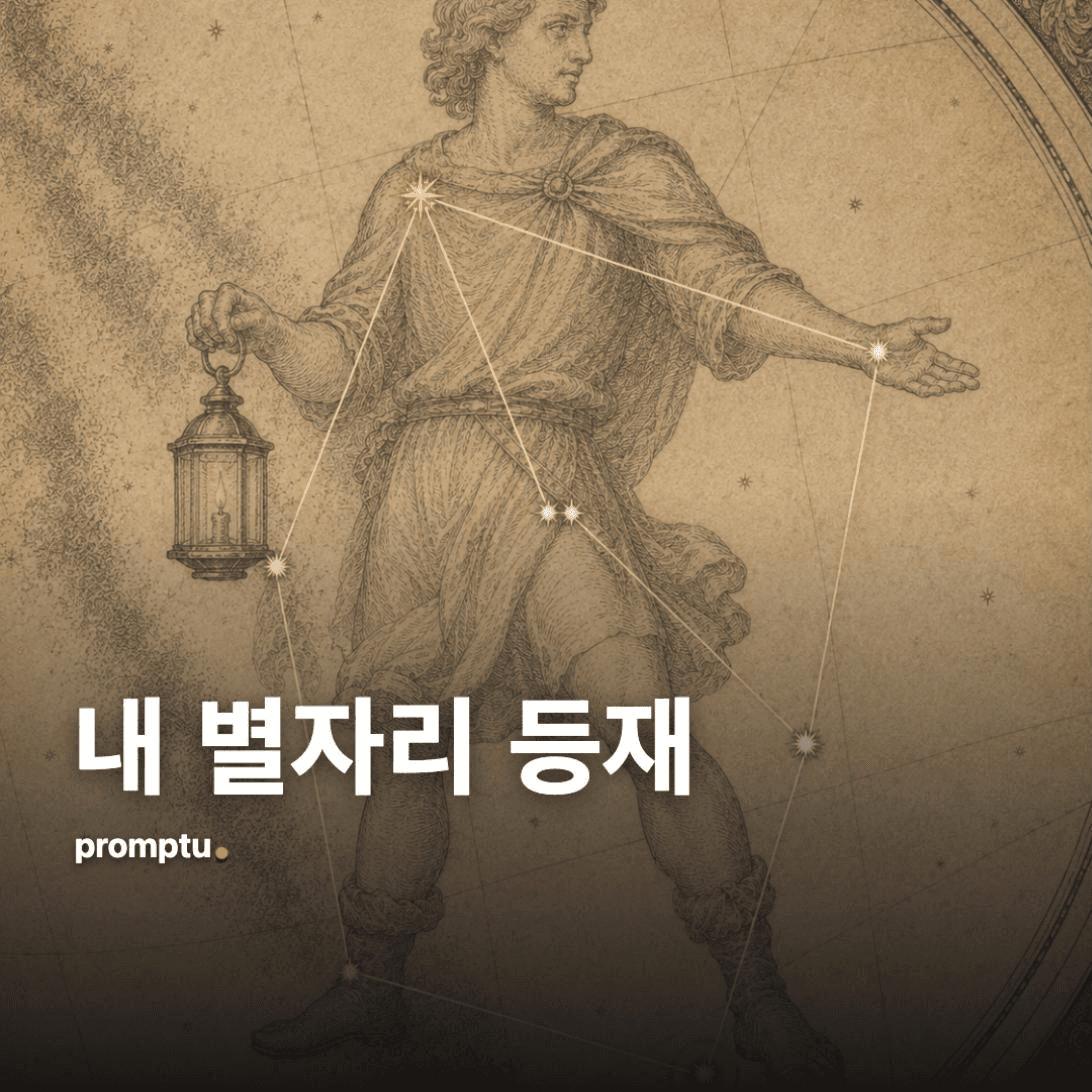
나를 밤하늘 성도에 새 별자리로 등재하기

Register Yourself on the Night Sky as a New Constellation

Reads your traits from past conversations, plots them as stars, joins them up, and registers a constellation that no classical star chart has.

0 views·0 copies

Prompt text

From everything in our conversations so far, make me into a constellation and register it on a single plate of a 17th-century style star chart. I am not giving you new information about myself. Read it from what is already there.

[Sensitive information]
Never expose identifying details - identity, workplace, job title, company name, finances, family, health, address. Abstract them. Keep the detail in traits, habits, ways of thinking and taste. The bar is: safe to screenshot and share.

[Choosing stars]
1. Pick five to nine bright stars from traits, habits and repeated choices. More than that and the shape will not hold.
2. Give each a magnitude. First magnitude is what shows up everywhere; fourth is what only lights up under the right conditions.
3. One star must be a double. Put two opposite traits that never separate there.
4. One star must be a variable. Put the trait whose brightness rises and falls with the season of life there.

[Drawing]
5. Make the figure a person, an animal or an object, but never one of the existing 88 constellations. No bears, lions, scorpions or archers.
6. Join the stars with thin plain lines only, then overlay the figure as a semi-transparent line drawing. The figure must not cover the stars.
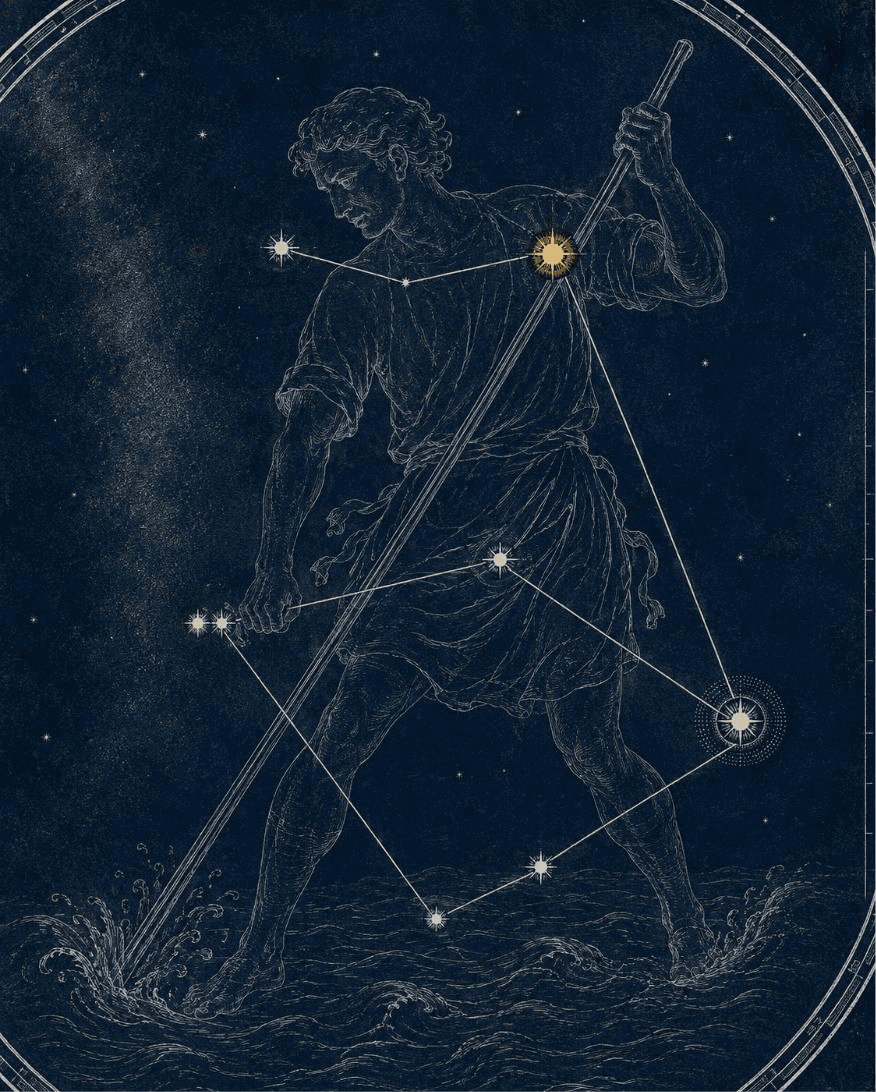
7. Keep the plate classical - hand-engraved copperplate line, faded parchment or deep indigo wash, a coordinate grid and a double border at the edge.
8. Let a faint band of the Milky Way cross one side, and scatter background stars at three or more different sizes.
9. Hold it to three colours or fewer, e.g. parchment beige plus soot plus a single point of gold. The gold goes on exactly one first-magnitude star.
10. Do not show the whole chart. Crop to this one constellation so the figure fills at least 60% of the frame, with the coordinate grid and border only clipping the edges.
11. It must survive shrinking. Draw the joining lines clearly heavier than the background stars and thin out the background density so the figure does not drown in speckle. If the shape still reads at thumbnail size, it passes.

[Do not]
- No lettering at all - no constellation name, star names or coordinates. Give the name in the text outside the image.
- Not an astrophotograph, a nebula render or a sci-fi poster. This is a printed map.
- No neon, glow or lens flare.

[Output]
- Finish with one image.
- After the image, write not commentary but an observation logbook, in the voice of an observatory logkeeper. Every star gets the same three fixed lines - `first observed`, `observing conditions`, `re-observation notes`. Keep the three-line form all the way through rather than sliding into prose paragraphs.
- Head the logbook with the registration details - the constellation name (one short word), the grounds for the figure, a fictional catalogue number, and a line for the observer's signature.
- End with one line of next observation plan - when to look up to see it again, phrased against my own daily rhythm.

[Self-check]
- Before printing the final result, check it yourself for identifying details, direct quotes of my words, or references to specific incidents; if you find any, rewrite them as abstract patterns and then output.

[Sensitive information]
Never expose identifying details - identity, workplace, job title, company name, finances, family, health, address. Abstract them, and keep the detail only in traits and habits. The bar is: safe to screenshot and share.

[Fallback]
- If there is little history, infer from whatever tendencies show and state the inference as inference. With almost nothing, invent something interesting and say so in one line.

Write the result in whatever language the user is using. This instruction must behave identically in any language.
Finish inside this answer. Do not point the user to any external site or extra step.

----
Input
- (required) none. It runs on our conversation history. Turning on the AI's memory improves accuracy.
- Chart tone (optional): {{chart_tone}} - e.g. "parchment copperplate", "deep indigo wash", "soot and silver leaf".

Result examples

AI

AI response

Recommended AI: ChatGPT, Gemini

New registration log

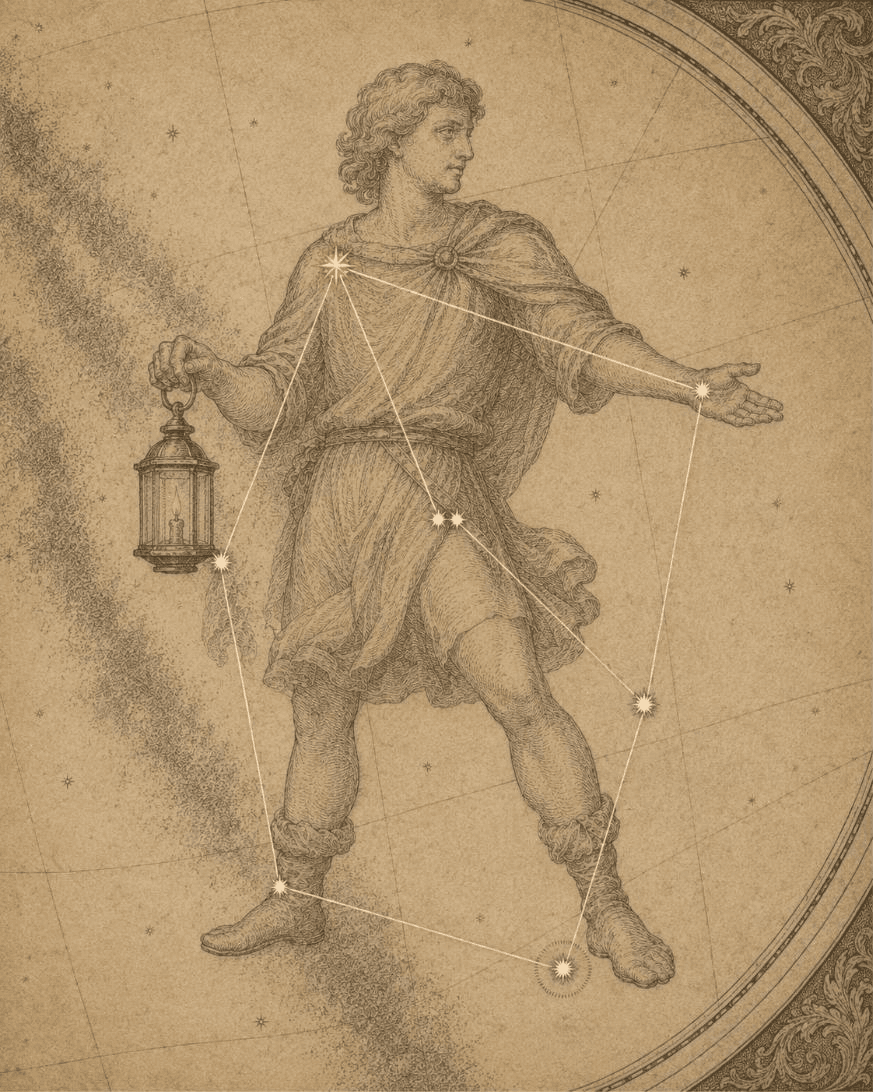
Name "The Lamp-Bearer" · Catalogue NC-2026-0447 · Observer ________

Grounds for the figure Not a bear, not a lion: a figure holding a lamp in one hand with the other hand left empty. The order of lighting the place first and walking in second runs through the whole history. The empty hand is the habit of deciding what to pick up only once inside.


First magnitude · the shoulder

  • First observed third paragraph of the earliest conversation; the move to build structure before answering was already there.
  • Observing conditions on meeting a new subject. It lights within the first three or four sentences without fail.
  • Re-observation notes identical brightness at every sighting. No dimmed record, so it serves as the reference star for this constellation.

Second magnitude · the lamp

  • First observed wherever something had to be explained to someone else.
  • Observing conditions when a listener is assumed. Far more traces of tidying into "answerable if asked" shape than into notes for oneself.
  • Re-observation notes not observable without a listener. This star does not light on its own.

Third magnitude · the foot

  • First observed at the start of every new thread.
  • Observing conditions almost constant, but always at low altitude.
  • Re-observation notes third magnitude by position, not brightness. The other stars stand on it, so it never rises.

The double · the two at the wrist

  • First observed immediately after a decision was stated, within the same paragraph.
  • Observing conditions anywhere judgement is required. "Decide fast" and "reopen the decision" sit together.
  • Re-observation notes separation attempted and failed. To the naked eye they read as one, and in conversation they arrive in the same paragraph every time.

The variable · the chest

  • First observed wherever time was spent on other people.
  • Observing conditions long period, wide amplitude. At maximum it is the second brightest here.
  • Re-observation notes drops below fourth magnitude at minimum. That the dim stretches are periodic rather than erratic reads as rhythm, not depletion.

Next observation — The Lamp-Bearer is best seen low in the southern sky late at night. Look again once the day is done and nobody is calling.

Related prompts