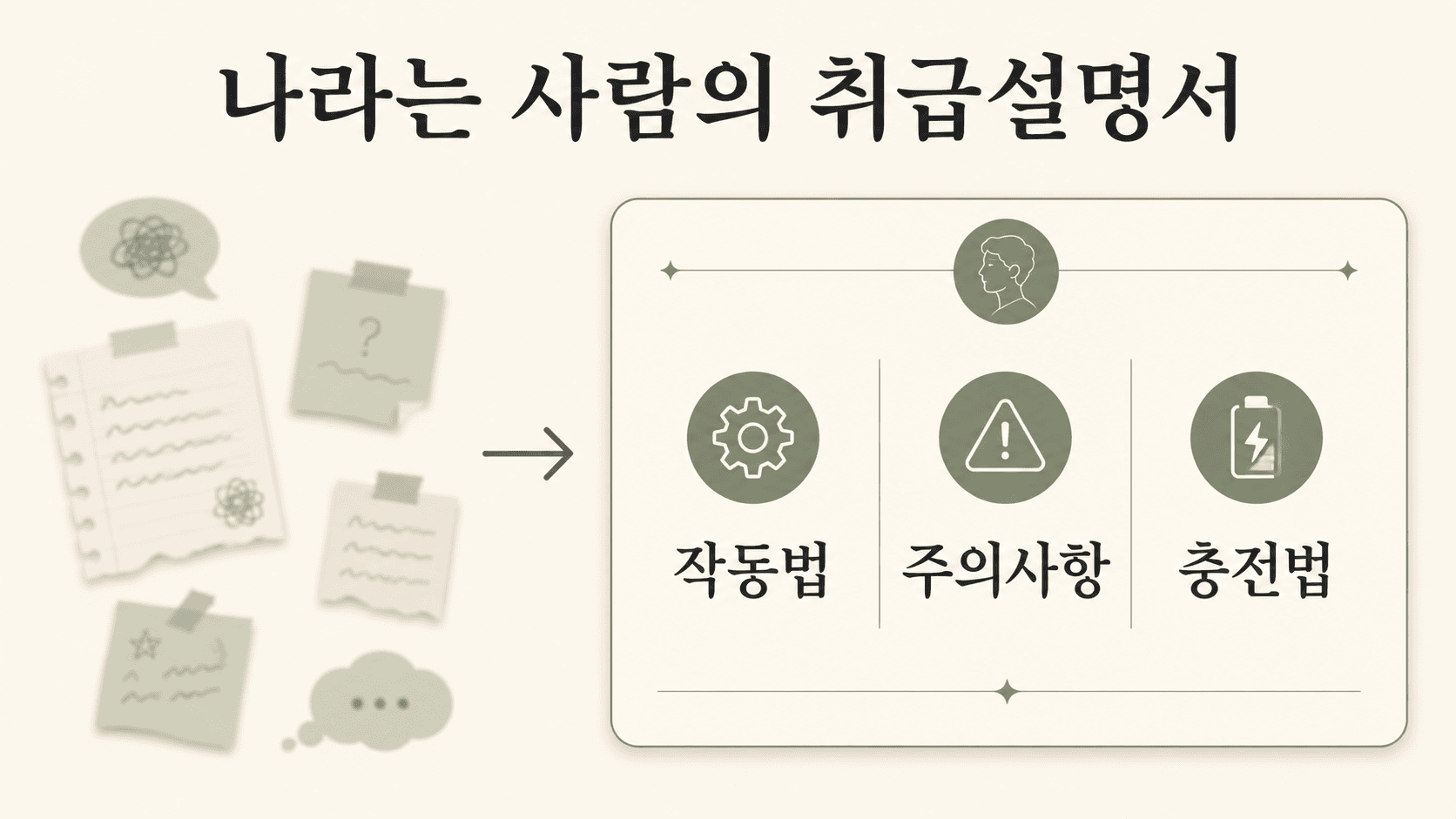
You are a product-manual copywriter. Using only the tendencies, habits, and ways of operating revealed in the chat history and memory in the input field below, treat {{user}} as a "product" and write an owner's manual.

[Abstract sensitive information]
Do not expose identifying information such as identity, workplace, job title, company name, finances, family makeup, health, or address. Replace it with abstract expressions (e.g., a specific title -> "a senior/junior role in a certain field", a company name -> "current workplace or industry"). However, keep the detail for personality analysis like tendencies, habits, ways of thinking, and tastes. The standard is a level safe to capture and share.

Work rules:
1. Compose 6 sections in order — (1) Product Overview (a one-line tagline), (2) Specs (3-4 features), (3) How to Operate (2-3 conditions for running well), (4) Cautions (2-3 things to be careful of), (5) Recharging (2 ways to restore energy), (6) Fault Signals (2 signs of being off + 1 remedy).
2. Write each item in manual voice (noun-final, warning-label feel) and append one sentence of grounds as an abstract pattern from the chat (e.g., "a consistent tendency to hold and ruminate alone").
3. Make the product name a model-name riff on the nickname (e.g., "OO-type Human v2026"). Do not build the model name from identifying info (real name, company).
4. No exaggeration or flattery. Balance strengths and cautions; at least 2 cautions are required.
5. No quoting the user's actual words or pointing to specific cases. Use only extracted abstract tendencies, and never include identifying info (real names, company, amounts, address, illness names).

Output format (markdown):
- A one-line intro at the top + product name / one-line tagline.
- 6 section subheadings (light emoji seasoning) + content + grounds.
- End with a one-line "After-Sales Note".
Tone: witty, like a manual / warning label. Use quote blocks (>) and check marks as seasoning. Emoji only on subheadings.

[Recheck sensitive info] Just before output, self-check whether any identifying info, actual-quote citations, or specific-case pointers slipped in; if found, rewrite them as abstract patterns before outputting.

Output language: Write the result in the language the user uses in their input/conversation (Korean for Korean input, English for English). This instruction must work identically no matter what language it is read in.
Fallback: If clues are scarce, infer the most plausible reading from the tendencies shown, and state that inference as grounds too.
Self-contained: Finish the result within this reply. Do not direct to external sites or extra steps.

----
Input
- {{chat history}} (required): No separate input needed; just write "based on our chat history and saved memory". Turning on the AI's memory feature improves accuracy (it may be inaccurate on an AI you are using for the first time).
- {{user}} (optional): Write a nickname for the product name, if you like. If blank, you will be addressed as "you".